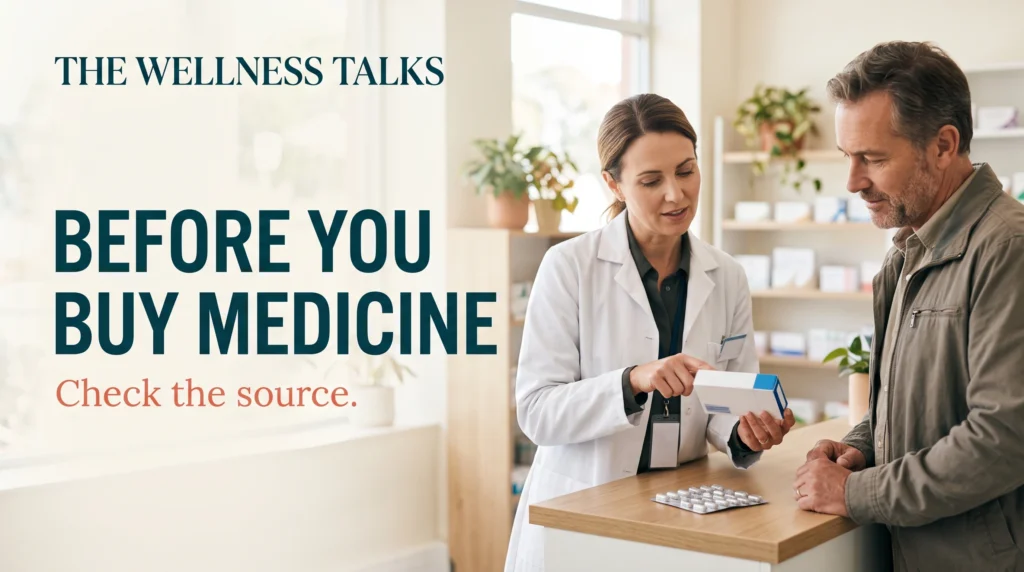
Buying medicines online can be convenient, but the first check should be who supplies them. A convincing website, familiar-looking carton or large discount cannot establish that a medicine is genuine. Use a licensed source and ask a pharmacist about anything unexpected before taking a product you cannot verify.
On 16 October, WHO and INTERPOL announced closer cooperation on threats connecting public health and crime, including falsified medicines, vaccines and medical devices. The announcement concerns coordination between authorities. For patients, it offers a useful reminder that the route a medicine takes to reach them matters.
Most people cannot test a tablet’s contents at home. What they can do is make the purchase traceable, notice warning signs and get the right help when something seems wrong.
What a medicine quality problem actually means
Two terms often become mixed together. A substandard medicine fails relevant quality requirements. A falsified medicine deliberately misrepresents what it is, what it contains or where it comes from. Both can harm patients, but the underlying problem is different. A manufacturing failure is not automatically evidence of deliberate fraud.
An unsafe product may contain too little active ingredient, the wrong ingredient or a contaminant. Sometimes the harm is immediate. Sometimes the problem is that the expected treatment never arrives, while the illness continues.
That distinction also explains why appearance is an incomplete test. A damaged pack deserves attention, but an attractive one cannot prove what is inside. Equally, a medicine that does not seem to be working is not automatically fake. Its effect needs professional assessment alongside the diagnosis, dose and way it has been taken.
Check the seller before comparing prices
The FDA advises US consumers to look for an online pharmacy that requires an appropriate prescription, has a physical US address, is licensed by the relevant state pharmacy board and makes a licensed pharmacist available for questions. A website that offers prescription medicines without a prescription is a warning sign.
Readers elsewhere should use their own country’s licensing arrangements. A US registration rule is not a worldwide test. Ask a known local pharmacist how to verify a seller, particularly when the business supplying the medicine is different from the app taking payment.
Before checkout, make a small practical record: the pharmacy name, the product ordered and the order confirmation. Keep the invoice after delivery. These records make a later conversation more specific than “I bought it from a website.”
Consider a hypothetical purchase in which two sites list the same medicine. One identifies the dispensing pharmacy and provides a pharmacist contact. The other accepts payment through a chat message and cannot explain who dispenses the order. The price difference should not be the only factor in that decision. The missing information itself deserves an answer.
What you can check when the parcel arrives
WHO recommends examining the pack, manufacturing and expiry dates, product appearance and any security seals. Where inner and outer packaging carry batch and expiry details, check that they agree. Confirm that the medicine and strength match the order. Report unexpected changes to a pharmacist or clinician.
Treat these as screening checks, not a home authentication service. A copied barcode, a neat hologram or a convincing photograph cannot settle every question about a product’s contents.
Avoid conducting your own taste test or taking an extra dose to see whether the product “feels strong enough.” Put the packaging somewhere you can find it again and seek professional advice. A clear photograph of the label can help with the initial conversation, but keep the actual pack if further inspection is needed.
It also helps to describe what changed precisely. “The new tablets are a different colour” is more useful than “this looks suspicious.” Include the name, strength, supplier and date received. That gives the pharmacist a starting point for checking whether the change is expected.
A lower price does not make a generic medicine fake
Approved generic medicines are a legitimate way to reduce costs. The FDA requires US-approved generics to match their reference medicine in active ingredient, strength, dosage form and route of administration, and to demonstrate equivalent performance. Their appearance can differ, so a colour change alone does not establish fraud.
The practical question is whether the product is authorised and appropriately supplied in your country. “Generic,” “cheap” and “falsified” are not interchangeable descriptions.
If the price of an ongoing prescription is becoming difficult, discuss an affordable authorised option with the prescriber or pharmacist. That conversation preserves a route back to professional advice. Quietly stretching doses or buying an uncertain substitute leaves the person managing both the original illness and an additional unanswered question about the treatment.
What to do when you suspect a problem
Contact a pharmacist or the prescribing clinician promptly. Explain whether you have taken the medicine and whether you noticed symptoms or an unexpected lack of effect. WHO also advises reporting suspected products to the national medicines regulator.
Ask specifically what to do about the next scheduled dose and how to obtain a verified replacement. Do not simply abandon essential treatment while investigating a concern. If symptoms are severe or rapidly worsening, seek urgent medical care rather than waiting for a retailer’s refund decision.
Keep the pack separate from other supplies. Retain the invoice and record when it was used. A refund and a health assessment answer different questions: one concerns the purchase, while the other concerns exposure and continuity of care.
A useful message might read: “I received this medicine from this pharmacy on this date. The label differs from my previous pack. I have taken this many doses. Please help me confirm the product and advise me about my next dose.” There is no need to diagnose fraud yourself before asking for help.
Reading an alert without creating unnecessary alarm
India’s Central Drugs Standard Control Organization provides official alerts and a route to Not Standard Quality notices. Start with the regulator’s notice rather than a cropped social-media image.
Read the scope carefully. A notice may identify a product, manufacturer, strength, batch or particular quality issue. Do not turn a finding about one listed sample into a claim about every medicine with a similar name. If the details are difficult to interpret, take the notice and your pack to a pharmacist.
When sharing an alert with family, include the original link and publication date. Older warnings often circulate without context. A useful message explains which product details need checking; it does not tell everyone to stop all medicines from an entire category.
A practical takeaway for the next refill
Before your next order, identify who will dispense it and how you would contact a pharmacist. When it arrives, compare it with the prescription and retain the purchase record. If a concern appears, ask for a plan that checks the product and keeps necessary treatment on track.
The aim is a purchase you can verify and a problem you can explain clearly. Those are more useful safeguards than trying to judge medicine quality from advertising or packaging alone.
Frequently asked questions
Can an authentic looking box contain a falsified medicine
Yes. WHO warns that some falsified products are very difficult to distinguish visually. Packaging checks can reveal concerns but cannot prove authenticity.
Are all online pharmacies unsafe
No. Legitimate online pharmacies exist. Verify the seller through the licensing system in your country and make sure a pharmacist can answer questions.
Does a cheap medicine mean it is fake
No. Approved generics can cost less for legitimate reasons. Price should be considered alongside authorisation and the dispensing source.
Should I stop a regular medicine if the pack looks different
Ask the pharmacist or prescriber promptly about the product and your next dose. A different appearance needs checking but does not, by itself, prove a quality problem.
Where should I check a medicine alert in India
Use the CDSCO website and the relevant state medicines authority. Compare the actual notice with the full details on your pack.
References
- WHO and INTERPOL cooperation agreement, 16 October 2026
- WHO advice to patients and consumers, 9 December 2019
- FDA BeSafeRx frequently asked questions
- WHO substandard and falsified medical products fact sheet, 3 December 2024
- FDA Generic Drug Facts
- CDSCO official alerts
Sources checked on 19 October 2026. Educational information; individual medicine concerns require a pharmacist or qualified clinician.