
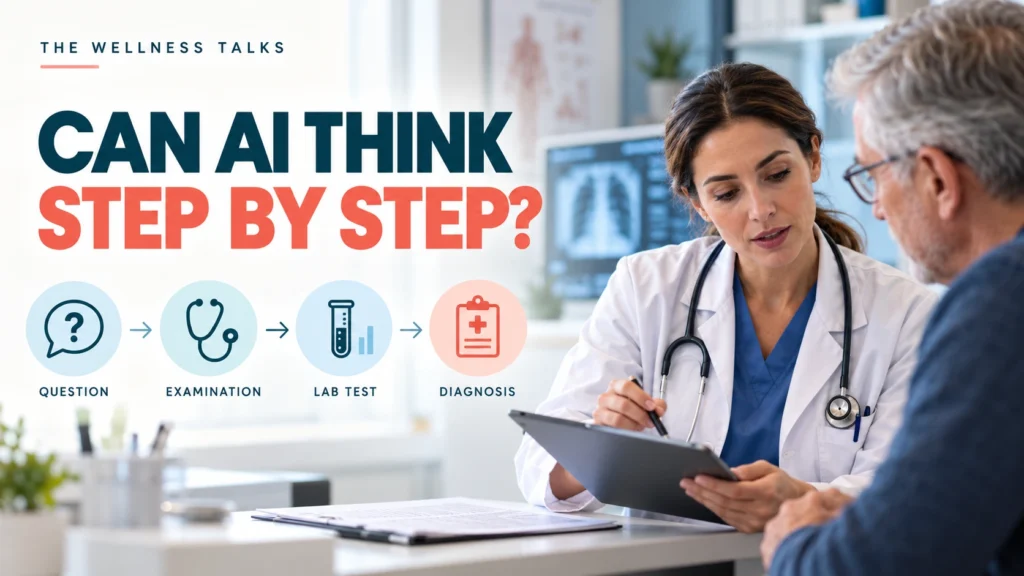
A new AI system was designed to investigate medical cases in stages-asking questions, choosing examinations, ordering tests and updating its diagnosis as new information appeared. It performed strongly in research evaluations, but it has not proved that a chatbot can safely replace a clinician in everyday care.
Why sequence matters in medicine
Many medical-AI tests give a model a complete case summary. The symptoms, history, examination, laboratory results and scan findings are already organised. The model’s task is to choose the most likely diagnosis.
Real clinical work begins earlier. A person may say only, “I feel weak,” “my stomach hurts,” or “I cannot catch my breath.” The clinician must decide which details matter, what to examine, whether a test will change the plan and how urgently action is needed.
Each answer changes the next question. Sudden chest pain during exercise leads down a different path from a brief sharp pain that changes with movement. A negative test may lower one possibility but raise another. Good diagnosis is therefore not only pattern matching; it is the controlled gathering and interpretation of information over time.
The study published in Science attempted to model this sequence. An “orchestrator” coordinated simulated clinical experts. The system chose questions and tests, reviewed the new results and revised its working hypotheses rather than receiving everything at once.
What the researchers found
The researchers evaluated the system on more than 300 unusual and difficult published medical cases. General physicians were allowed to use textbooks and the internet. The orchestrated AI system was reported to be more than twice as accurate in working through the cases and reaching the final diagnosis.
The system also performed strongly on scenarios drawn from a large emergency-department admissions database. Researchers reported that its diagnostic work-ups cost less in the simulation because it selected fewer or less expensive steps while still reaching accurate answers.
These results are noteworthy for two reasons. First, the system was tested on an interactive process rather than a multiple-choice exam. Second, the study considered resource use as well as diagnostic accuracy. Ordering every available test might eventually reveal an answer, but it is not efficient or safe clinical practice.
However, “cost” in a benchmark is not the same as the actual financial, emotional and medical cost of care. A delayed scan, false reassurance or unnecessary invasive test has consequences that a simplified model may not fully capture.
Why a benchmark is not a clinic
Published diagnostic puzzles are often selected because they are unusual. The final diagnosis is known, the records are relatively complete and the case has an educational narrative. Everyday practice contains missing information, language barriers, several illnesses at once and symptoms that change while the patient waits.
Doctors also observe things that are difficult to convert into text. A person’s effort of breathing, ability to walk, skin colour, confusion, distress and family account may change the urgency even before a formal diagnosis is reached.
The comparison with general physicians must also be interpreted in context. It does not mean the AI is “twice as good as every doctor.” Performance depends on the selected cases, the instructions, which tools participants could use, the scoring method and the clinical experience represented.
A system can be excellent at identifying rare diagnoses yet still be unsafe if it misses common emergencies, behaves inconsistently across demographic groups or gives confident advice when data are incomplete. Clinical validation must therefore include ordinary cases, different settings and meaningful safety outcomes.
Triage and diagnosis are different jobs
The research team plans to test the system with Beth Israel Deaconess Medical Center for triage in emergency-department waiting rooms. Triage asks: who needs attention first, what immediate precautions are required and which pathway is appropriate? It may not require a final diagnosis.
That distinction matters. An AI tool could be helpful if it identifies that a person with chest pressure, sweating and breathlessness should receive immediate assessment, even before the cause is confirmed. It could be dangerous if it offers a neat diagnosis but delays emergency care.
Prospective testing means studying the tool as cases arrive rather than replaying records after outcomes are known. Researchers will need to measure missed emergencies, over-triage, time to care, clinician workload, patient understanding and whether performance differs by age, sex, language, disability or other factors.
Human oversight must be more than a slogan. Staff need to know when to ignore the tool, how uncertainty is displayed and who is responsible when recommendations conflict.
What patients can safely do with AI today
AI can help a patient organise information before an appointment. It may suggest a symptom timeline, turn medicine labels into a list, explain unfamiliar terms or help draft questions. This can make a short consultation more productive.
It can also support general education when the source is checked. A patient might ask what a blood test measures or what preparation is usually needed. The answer should still be compared with instructions from the treating clinic because local protocols and individual circumstances differ.
AI should not be treated as the final authority for a new serious symptom. It cannot perform a physical examination, verify that a home measurement is accurate or guarantee that the history entered is complete. A polished answer may still be wrong.
Do not enter identifiable medical records into a public tool without understanding its privacy terms. Remove names, addresses, identification numbers and other details where possible. Workplace or insurer-provided systems may have different rules from consumer chatbots.
Red flags should bypass the chatbot
Call emergency services or seek urgent care for severe breathing difficulty, new weakness on one side, facial droop, sudden confusion, seizure, major bleeding, blue lips, severe allergic reaction, loss of consciousness or crushing chest pain. The exact emergency number and route to care depend on location.
Children, pregnant people, older adults and immunocompromised patients may deteriorate differently or more quickly. When symptoms are severe or changing rapidly, a long chatbot conversation is the wrong next step.
For non-emergency symptoms, an AI-generated summary can be brought to a clinician as a starting point, not a verdict. Include when the problem began, what makes it better or worse, important medical history, medicines and any measurements taken.
The most useful future may be collaboration
Healthcare already contains many points where information is lost: incomplete histories, delayed records, overloaded inboxes and test results that are difficult to interpret. A sequential AI system could help structure these tasks, remind clinicians of possibilities or reduce unnecessary testing.
Its value will depend on integration. A tool that adds another alert or produces long explanations may increase workload. A tool that makes its reasoning traceable, shows uncertainty and fits existing clinical pathways may be more useful.
The new study advances diagnostic-AI research because it evaluates a process closer to real investigation than a static exam question. The responsible conclusion is not that doctors have been replaced. It is that researchers now have a stronger way to test whether AI can gather medical information intelligently-and a clear need to prove safety with real patients.
People also ask
Did the AI really outperform doctors?
It outperformed participating general physicians in the study’s selected simulated cases. That result does not establish superiority over clinicians in all specialties, hospitals or real-world populations.
Can this AI diagnose me now?
The researched system is not presented as an independent consumer diagnostic service. It requires prospective clinical testing and regulatory and organisational safeguards before routine use.
What is sequential diagnosis?
It is the process of gathering information in stages: asking a question, examining, ordering a relevant test, reviewing the result and updating the diagnostic plan.
Why not order every medical test?
Tests can produce false positives, radiation exposure, complications, cost and delay. Good care selects tests likely to change the diagnosis or treatment plan.
Is AI safe for symptom checking?
It may help organise information, but it can miss emergencies or give overconfident answers. Serious or rapidly worsening symptoms need professional assessment.
Will AI replace doctors?
This study does not show that. Diagnosis also involves examination, communication, procedures, responsibility and decisions shaped by the patient’s values and circumstances.
How can I protect my privacy when using health AI?
Avoid entering names, identification numbers, exact addresses or complete records unless you understand how the system stores and uses data. Use approved clinical channels when available.
References
- “Sequential diagnosis with language models.” Published 22 October 2026.
- “Microsoft develops AI tool that can diagnose ‘sequentially’ like a doctor.” 23 October 2026.